



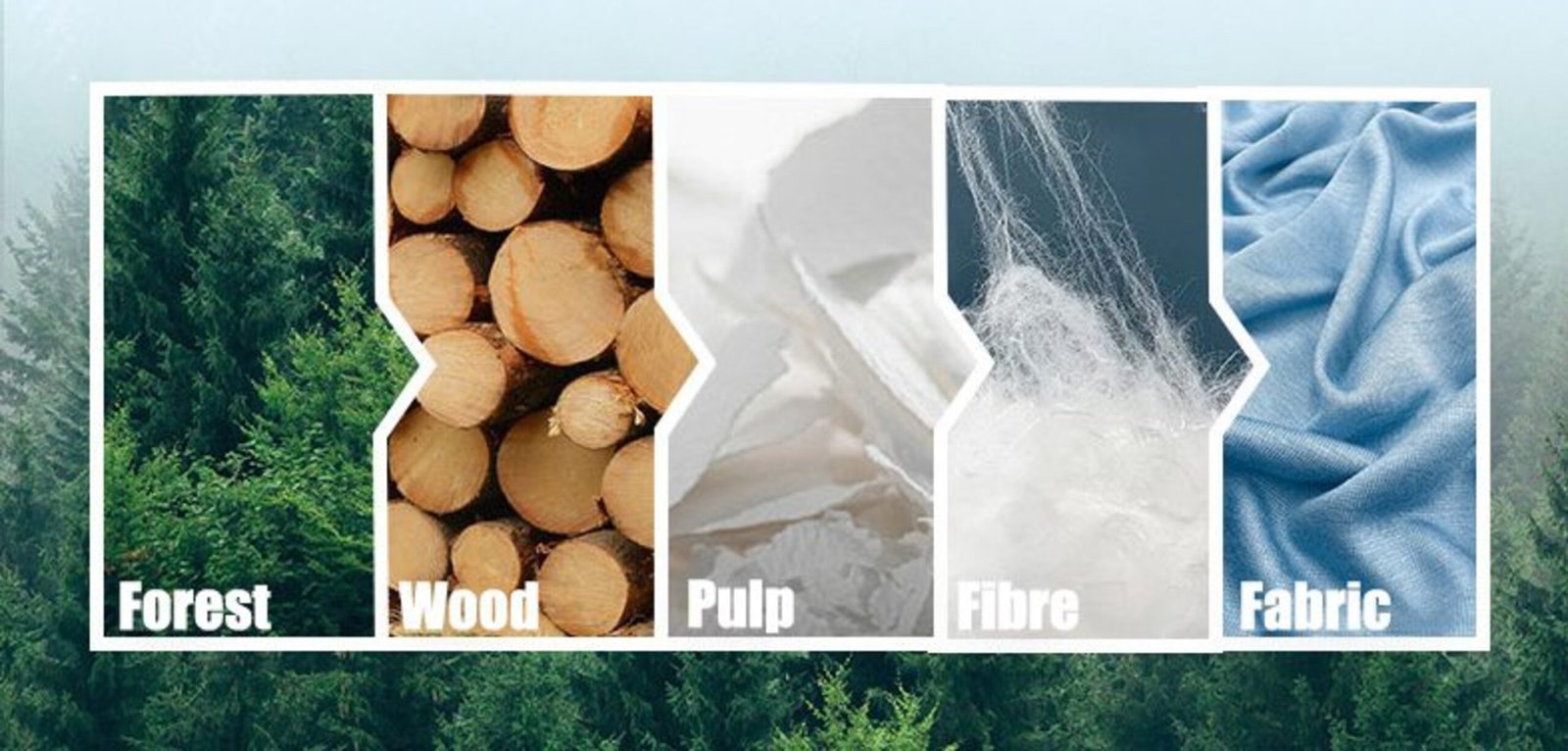
The global textile industry is undergoing a significant transformation driven by increasing demand for sustainable and high-performance materials. At the forefront of this shift are advanced cellulosic fibers, which offer a compelling alternative to both conventional cotton and synthetic polymers.
For decades, traditional viscose rayon has been widely used in textiles; however, its manufacturing process raises considerable environmental concerns due to high chemical consumption and waste generation. In response, next-generation fibers such as Modal and Lyocell (commercially known as Tencel™) have emerged as more sustainable solutions.
These fibers originate from the same fundamental raw material—wood pulp—but are produced through advanced manufacturing processes designed to minimize environmental impact. In particular, the use of closed-loop production systems significantly reduces chemical waste and water consumption.
This article explores the science, production technologies, performance characteristics, and sustainability advantages of Modal and Lyocell/Tencel, highlighting their growing importance in the future of eco-friendly textiles.
Modal Fiber Science
Modal is a regenerated cellulosic fiber classified as a High Wet Modulus (HWM) rayon. This classification indicates that the fiber retains high strength and dimensional stability even when wet, unlike conventional viscose.
Modal is typically produced from beech tree pulp, which is often sourced from sustainably managed forests. Beech trees require minimal irrigation and generally do not require pesticides, making them a more environmentally responsible raw material compared with many traditional crops used in textile production.
The manufacturing process of Modal begins similarly to viscose production, where purified wood pulp is chemically dissolved to form a spinning solution. However, the subsequent regeneration and fiber formation processes are optimized to produce fibers with a higher degree of polymerization.
As a result, Modal fibers exhibit:
- Exceptional softness and smoothness
- High tensile strength
- Superior moisture absorption
- Excellent dimensional stability
Modal fibers also possess a smooth surface and nearly circular cross-section, which contribute to their characteristic silky texture and natural sheen in finished fabrics.
Lyocell and Tencel Production Process
Lyocell represents a major technological advancement in regenerated cellulosic fiber production. The most well-known commercial brand of Lyocell is Tencel™, produced by Lenzing AG.
What distinguishes Lyocell from other regenerated fibers is its environmentally advanced closed-loop manufacturing process, which recovers and reuses more than 99% of the solvents and water used during production.
The process involves several key steps:
- Raw Material Preparation
Wood pulp is typically sourced from sustainably harvested eucalyptus trees, known for their rapid growth and low water requirements. - Dissolution
The cellulose pulp is dissolved in a non-toxic organic solvent called N-Methylmorpholine N-oxide (NMMO). - Spinning
The cellulose solution is heated and extruded through fine spinnerets, forming continuous filaments. - Solvent Recovery
During fiber formation, the solvent-water mixture is captured, purified, and recycled for reuse in subsequent production cycles.
This highly efficient recovery system significantly reduces chemical emissions, water usage, and environmental pollution, making Lyocell one of the most sustainable fiber technologies currently available.
Performance and Sustainability
The combination of high performance and strong environmental credentials makes Modal and Lyocell truly next-generation textile fibers.
Performance Characteristics
Modal
- Extremely soft and smooth texture
- Excellent color retention after repeated washing
- Approximately 50% more absorbent than cotton
- High resistance to shrinkage and fading
- Ideal for daily wear and activewear
Lyocell / Tencel
- High strength in both wet and dry conditions
- Soft hand feel with elegant drape
- Natural moisture-wicking properties
- Breathable and comfortable for extended wear
- Fibers can be engineered to produce different surface textures
Sustainability Advantages
Renewable Raw Materials
Both Modal and Lyocell are derived from wood pulp obtained from FSC® or PEFC™ certified forests, ensuring responsible forest management and biodiversity protection.
Reduced Water and Land Use
Eucalyptus and beech trees require significantly less water and fewer agricultural inputs than cotton cultivation.
Efficient Chemical Management
- Modal uses a more efficient production process than conventional viscose.
- Lyocell employs the NMMO solvent system, which is non-toxic and recycled within a closed-loop process.
Biodegradability
Both fibers are fully biodegradable and compostable, allowing them to break down naturally in soil or marine environments without contributing to microplastic pollution.
Applications
Due to their superior properties, Modal and Lyocell fibers are widely used across numerous textile applications.
Apparel
Modal is commonly used in:
- Premium underwear
- Loungewear
- T-shirts
- Bed linens
Lyocell is increasingly used in:
- Fashion garments
- Dresses and blouses
- Denim fabrics
- Activewear
Its excellent drape, strength, and moisture management make it highly attractive to modern apparel brands.
Technical Textiles
Lyocell fibers are also used in medical and technical textiles, including:
- Wound dressings
- Protective clothing
- Hygiene products
Nonwoven Products
Both fibers are widely utilized in high-quality nonwoven products, such as:
- Cosmetic pads
- Personal care wipes
- Industrial wipes
Their purity, softness, and absorbency make them ideal for these applications.
Market Growth
The global market for advanced cellulosic fibers is experiencing rapid growth. Industry reports indicate that the Lyocell fiber market is expected to grow at a compound annual growth rate (CAGR) of over 8% in the coming years. Demand for Modal is also increasing steadily.
Several factors are driving this expansion:
Rising Consumer Awareness
Consumers are increasingly seeking sustainable and ethically produced textiles.
Brand Sustainability Initiatives
Major fashion brands are incorporating eco-friendly fibers to meet sustainability commitments and attract environmentally conscious consumers.
Environmental Regulations
Stricter global regulations on pollution and chemical emissions are encouraging the adoption of cleaner manufacturing technologies.
Comparison with Viscose
Although viscose, Modal, and Lyocell all belong to the category of regenerated cellulosic fibers, their environmental impact and performance characteristics differ significantly.
| Feature | Viscose (Conventional) | Modal | Lyocell / Tencel |
|---|---|---|---|
| Production Process | Conventional, high chemical usage | More efficient than viscose | Closed-loop solvent recycling |
| Environmental Impact | High pollution and toxic emissions | Lower impact than viscose | Minimal waste and emissions |
| Wet Strength | Low | Moderate to high | Very high |
| Softness | Good | Excellent | Excellent (silky) |
| Absorbency | Good | Very high | High |
| Biodegradability | Yes | Yes | Yes |
This comparison demonstrates the technological evolution from viscose to Lyocell, with Modal serving as an intermediate high-performance improvement.
Modal, Lyocell, and Tencel represent a significant advancement in the development of sustainable textile fibers. These materials successfully combine the comfort and natural feel of cellulose with the durability and performance of engineered fibers, while maintaining a strong commitment to environmental responsibility.
Modal provides a softer and more durable alternative to conventional viscose, while Lyocell—through its innovative closed-loop production technology—represents one of the most sustainable fiber manufacturing processes available today.
As the global textile industry continues to transition toward circular economy principles, the adoption of these next-generation fibers is expected to accelerate. Their combination of sustainability, performance, and versatility positions them as foundational materials for the future of responsible fashion and advanced textile engineering.
Written by: MD.Ashraf Ul Anam