



Growing geopolitical instability in the Middle East has exposed significant gaps in Bangladesh’s energy capacity, prompting urgent calls for reforms and long-term strategies to ensure energy security.
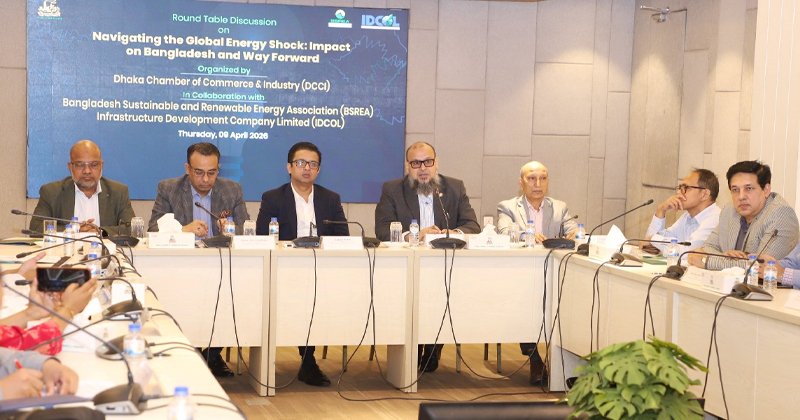
Speaking at a roundtable titled “Navigating the Global Energy Shock: Impact on Bangladesh and Way Forward,” Taskeen Ahmed, President of the Dhaka Chamber of Commerce and Industry (DCCI), stressed the need to expand both offshore and onshore gas exploration, diversify energy import sources, and accelerate investment in renewable energy.
The event, held on April 9 at the DCCI auditorium, was jointly organised with the Bangladesh Sustainable and Renewable Energy Association (BSREA) and Infrastructure Development Company Limited (IDCOL).
Rising Risks and Economic Impact
Taskeen Ahmed highlighted that nearly 20% of global oil and over 25% of LNG trade passes through the Strait of Hormuz, while Bangladesh imports around 95% of its energy—most of it via this route.
He warned that rising global oil prices could significantly increase national expenditure, noting that every $10 increase adds roughly $1 billion annually. If prices exceed $120 per barrel, additional costs could reach $4–5 billion.
The ongoing energy crisis is already impacting industries. Production capacity in the garment sector has reportedly declined by nearly 50%, while cement costs have increased and freight charges have risen by 20–40%, raising overall business expenses and cost of living.
Policy Gaps and Structural Challenges
Officials acknowledged long-standing structural challenges, including limited gas exploration, heavy import dependency, and bureaucratic delays.
Md Obaidur Rahman, Secretary of the Ministry of Industries, stated that persistent energy shortages have worsened due to global instability. He also pointed to fertilizer shortages and confirmed that an electric vehicle policy is nearing completion.
Speakers at the event emphasised the need for:
- Increased energy storage capacity
- Diversification of import sources
- Expansion of renewable energy adoption
- Reduction of tariffs and duties on solar equipment
- Improved policy coordination and faster implementation
Push for Renewable Energy and Investment
Industry stakeholders highlighted renewable energy as a key solution. Representatives from BSREA and other organisations called for reduced duties on solar equipment and access to long-term, low-interest financing for entrepreneurs.
Concerns were also raised over high subsidies in the energy sector. According to the Bangladesh Power Development Board (BPDB), subsidies reached nearly BDT 63,000 crore in FY2024–25 due to high production costs.
Experts stressed that increasing domestic gas exploration and improving energy efficiency are critical to reducing dependency on imports and controlling subsidy burdens.
Call for Coordinated Action
Participants urged the formation of a national-level taskforce to ensure effective coordination across ministries and faster implementation of energy policies.
Speakers also highlighted the importance of strong political will, policy consistency, and stakeholder collaboration to address the crisis and ensure long-term energy security.