



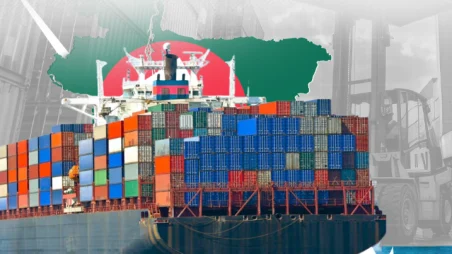
The Office of the United States Trade Representative (USTR) has launched an investigation into the manufacturing sectors of 16 economies, including Bangladesh, over concerns related to structural overcapacity and export-support policies under the Section 301 of the Trade Act of 1974.
According to a notice published in the Federal Register, Bangladesh is being reviewed for providing government cash incentives to export-oriented industries. The US authorities claim that such incentives, covering 43 sectors including textiles and leather products, may have contributed to Bangladesh’s $6.15 billion bilateral goods trade surplus with the United States.Bangladesh exports more than $8 billion worth of goods to the US annually, with ready-made garments accounting for the majority of shipments.
The investigation will assess whether these policies are “unreasonable or discriminatory” and whether they restrict or burden US commerce, said US Trade Representative Jamieson Greer.Apart from Bangladesh, economies under review include China, the European Union, India, Vietnam, Indonesia, Malaysia, Thailand, Cambodia, South Korea, Japan, Mexico, Singapore, Switzerland, Norway and Taiwan.
Responding to the development, Bangladesh Garment Manufacturers and Exporters Association (BGMEA) President Mahmud Hasan Khan described Bangladesh’s inclusion in the probe as “uncomfortable” and lacking logical justification. He warned that if the allegations are confirmed, the US could impose additional tariffs.
Former member of the Bangladesh Trade and Tariff Commission, Mostafa Abid Khan, said Bangladesh’s export incentives fall within the policy framework of the World Trade Organization (WTO) and are unlikely to encourage excessive production capacity.
The USTR has requested consultations with Bangladesh and other economies under review. A public comment period will open on 17 March, while a hearing is scheduled for 5 May, allowing stakeholders to submit written statements and testimony.