



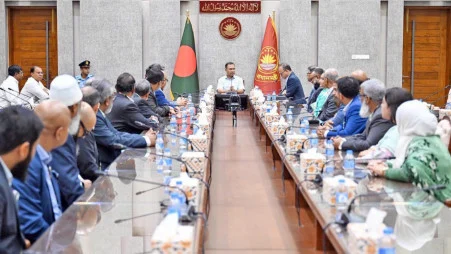
Prime Minister Tarique Rahman has assured Bangladesh’s business community that the government’s ongoing efforts to resolve the country’s energy crisis will deliver visible improvements within the next one to one-and-a-half years, while confirming that a decision on installing a new Floating Storage Regasification Unit (FSRU) will be taken within the next month.
The assurance came during separate meetings with leaders of the Bangladesh Garment Manufacturers and Exporters Association (BGMEA) and the Bangladesh Textile Mills Association (BTMA) at the Prime Minister’s Office on Tuesday, where industry representatives highlighted persistent gas shortages, financing challenges and regulatory hurdles affecting industrial production and investment.
Business leaders welcomed recent government initiatives, including the Tk20,000 crore working capital facility and enhanced export incentives for the textile sector, but stressed that sustainable industrial growth will remain difficult unless the ongoing energy crisis is resolved.
BGMEA President Mahmud Hasan Khan said the association identified the gas shortage as the industry’s most pressing challenge, alongside concerns over the National Board of Revenue’s audit process and customs-related complications.
According to BGMEA leaders, the Prime Minister acknowledged that the energy crisis cannot be resolved overnight due to inherited structural challenges but assured them that government measures would significantly improve gas and electricity supply within the next 12 to 18 months. He also announced plans to decide on establishing another FSRU within a month to increase LNG import capacity.
The garment manufacturers also submitted several policy recommendations, including restoring yarn imports from India through the Benapole land port, simplifying compliance with the Bangladesh National Building Code and environmental regulations, allocating land in Gazipur for a temporary garment workers’ hospital, creating a dedicated ministry for the textile and apparel sector, improving airport facilities for export cargo, and addressing concerns over customs and bonded warehouse audits.
BGMEA Senior Vice President Inamul Haq Khan said a committee comprising the Commerce Minister and the Prime Minister’s Economic Affairs Adviser has been formed to review the industry’s proposals and recommend practical solutions.
In a separate meeting, BTMA leaders urged the government to ease eligibility criteria for the Tk20,000 crore working capital programme, requesting that companies within the same business group should not be denied financing due to another company’s default status.
The textile association also proposed temporary relaxation of Credit Information Bureau (CIB) requirements, project-based loan evaluations, a preferential 5% lending rate for textile manufacturers, and faster government service delivery through a dedicated fast-track mechanism.
BTMA President Showkat Aziz Russell said the Prime Minister recognised the severity of the gas crisis but noted that restoring adequate supply would require time and sustained investment.
The urgency of the issue is reflected in current supply conditions. Many gas-dependent textile mills are reportedly receiving only 1.5 to 2 PSI pressure against approved levels of 10 to 15 PSI, significantly reducing production capacity. Household consumers have also experienced declining gas pressure in several parts of Dhaka.
According to information presented in Parliament earlier this month, Bangladesh’s daily gas demand stands at approximately 3,800 million cubic feet per day (mmcfd), while supply remains around 2,700 mmcfd, leaving a substantial deficit.
The Prime Minister also announced the formation of a high-level committee tasked with reviewing industry demands and submitting recommendations within a week, reaffirming the government’s commitment to strengthening industrial competitiveness, attracting investment and supporting long-term economic growth.