



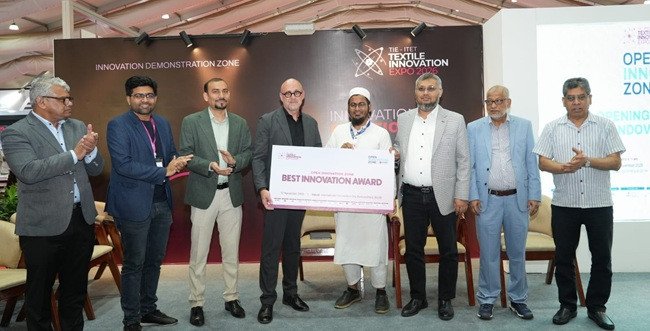
Advancing the development of high-value textile products through smart materials, wearable technologies and sustainable manufacturing, a Bangladesh–UK research collaboration has gained recognition at the TIE–ITET Textile Innovation Expo 2026.
Dr. Md. Shamim Alam of Southeast University, Dhaka, and Dr. Md. Raju Ahmed of The University of Manchester, UK, have jointly received the Best Innovation Award for three research-driven textile innovations addressing emerging industry challenges in sustainability, healthcare and smart clothing.
The award-winning projects were developed through the Sustainable Smart Textile Lab (SSFT), a research centre led by Dr. Shamim Alam. The research team also includes Md. Raihan Hossain of Northeast Normal University, China, and Southeast University textile engineering students Jubayer Ibn Asheque and Md. Mehedi Hasan.
The recognition was announced on 12 November 2026 at the Open Innovation Zone of the TIE–ITET Textile Innovation Expo, held at the International Convention City Bashundhara (ICCB), Dhaka. Organized by Textile Innovation Exchange (TIE) and the Institution of Textile Engineers and Technologists (ITET), the zone featured 18 shortlisted research projects selected from universities, researchers and emerging innovators.
Representing the research team, Dr. Alam presented the innovations at the exhibition, while Dr. Ahmed led the research and technical development behind the projects.
Three Innovations Addressing Emerging Textile Industry Challenges
The three award-winning developments demonstrate how textile engineering and advanced materials can contribute to new product opportunities beyond conventional apparel manufacturing.
FLUOROVA: Advancing PFAS-Free Waterproof Textiles
FLUOROVA introduces a waterproof and breathable textile solution developed without fluorinated PFAS chemicals, commonly known as forever chemicals because of their environmental persistence. The innovation addresses the growing demand for alternative textile finishing technologies as global brands and regulatory frameworks increasingly focus on eliminating PFAS from textile products.
FeMats: Integrating Maternal Health Monitoring into Textiles
FeMats is a graphene-enhanced wearable textile designed to support maternal and fetal health monitoring during pregnancy. By integrating functional materials into wearable textile structures, the innovation explores new possibilities for healthcare applications beyond traditional textile uses.
A patent application for the graphene-based wearable fetal and maternal monitoring system has been submitted through The University of Manchester’s Innovation Factory and is currently under review.
ThermoTex: Exploring Self-Charging Smart Heating Textiles
ThermoTex focuses on the development of smart heating textiles with energy-harvesting capabilities. The research draws on SSFT’s work on low-voltage textile heaters and printable graphene inks for textile thermoelectric generators, which convert body heat into electrical energy.
The technology aims to integrate heating functionality and energy generation into textile structures, opening opportunities for next-generation wearable applications.
Connecting Academic Research with Industrial Opportunities
The recognition highlights the growing importance of research collaboration in developing technologically advanced and commercially relevant textile products. The SSFT initiative connects research capabilities across Southeast University in Bangladesh, The University of Manchester in the UK and Northeast Normal University in China.
For Bangladesh’s textile and apparel industry, such developments offer opportunities to explore higher-value product segments, including functional textiles, wearable healthcare solutions and environmentally responsible materials.
Commenting on the achievement, Dr. Shamim Alam said that receiving the Best Innovation Award at the country’s first Textile Innovation Expo was a great honour. He emphasized that the real value of research lies in bringing industry leaders and researchers together to transform laboratory innovations into market-ready products and scalable solutions.
Dr. Raju Ahmed also expressed his appreciation for the recognition, highlighting his connection with Bangladesh, where his academic journey in textile research began. He expressed hope that the innovations would help local manufacturers explore opportunities in high-value smart and sustainable textiles.
Research Leadership and Academic Contributions
Dr. Md. Shamim Alam is an Associate Professor and Coordinator of the Department of Textile Engineering at Southeast University, where he leads the Sustainable Smart Textile Lab. He holds a PhD in Chemistry from Bangladesh University of Engineering and Technology (BUET) and received the university’s Top Researcher Award 2026 in the Senior Category.
Dr. Md. Raju Ahmed is a researcher and Adjunct Lecturer in the Department of Materials at The University of Manchester. With nearly a decade of experience in smart textiles and graphene-based functional materials, his research focuses on advanced materials and their applications in next-generation textile technologies. His recognitions include The Textile Institute’s Best Research Award 2024 and the Global Sensor Award 2025.
Other contributors to the research include Md. Raihan Hossain of Northeast Normal University, China, and Southeast University textile engineering students Jubayer Ibn Asheque and Md. Mehedi Hasan, who contributed to the development of FLUOROVA.
All 18 shortlisted innovators participating in the Open Innovation Zone received certificates of participation.
The achievement reflects the potential of stronger university–industry collaboration to accelerate textile innovation in Bangladesh. As global markets increasingly prioritize sustainability, functionality and technological advancement, research initiatives such as SSFT could contribute to the country’s transition towards more diversified and higher-value textile manufacturing.