



Glass fiber is a high-performance material made from extremely fine strands of glass. These fibers are lightweight, strong, heat-resistant and non-corrosive, making them one of the most widely used reinforcement materials in modern engineering and industrial applications. Glass fiber is incredibly versatile and is used to produce fiberglass composites, which combine glass fibers with polymer resins to create materials that are both strong and flexible. Because of their strength-to-weight ratio, stability and durability, glass fibers have become essential in textiles, construction, automotive manufacturing, aerospace engineering and even consumer goods.
Manufacturing Process
The production of glass fiber involves several carefully controlled steps to ensure strength and uniformity:
a. Raw Materials: The most common ingredients include silica sand, limestone, soda ash and various metal oxides. These materials determine the fiber’s strength, durability and thermal resistance.
b. Melting: The raw materials are heated in a furnace at around 1400–1500°C until they form molten glass. Maintaining consistent temperature is crucial for fiber quality.
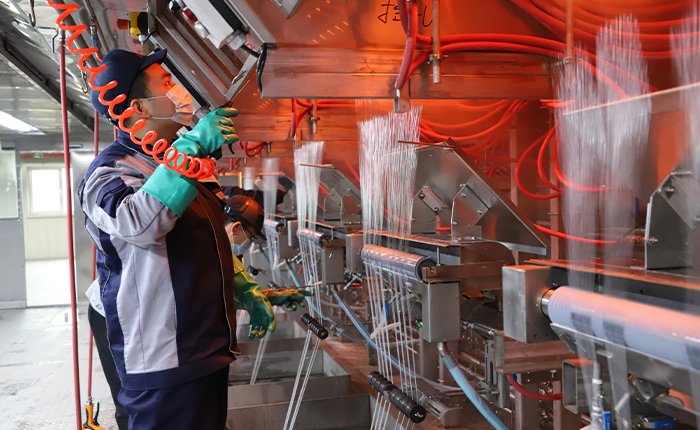
c. Fiber Formation: The molten glass is passed through a platinum alloy bushings plate with very fine holes. As the glass flows through these holes, it forms continuous filament strands.
d. Cooling & Applying Sizing: The hot filaments are rapidly cooled and coated with a protective chemical layer called sizing. Sizing improves flexibility, reduces breakage and enhances bonding with resin in composite production.
e. Winding & Packaging: The coated fibers are gathered into strands and wound into packages for further processing such as weaving, mat production or composite manufacturing.
Physical Properties
Glass fibers possess a combination of mechanical and chemical properties that make them highly valuable:
• High tensile strength: Their strength is several times greater than steel relative to weight. • Low density: They are extremely lightweight, ideal for designing strong but light structures.
• Thermal resistance: Glass fibers maintain stability at high temperatures. • Electrical insulation: They are excellent non-conductors, useful in electronics and infrastructure.
• Corrosion and chemical resistance: Glass fibers do not rust or degrade in harsh environments.
• Dimensional stability: They do not shrink or warp easily, giving composites long service life.
Composite Technology
Composite technology involves combining glass fibers with a polymer resin (like polyester, epoxy, or vinyl ester) to form a fiberglass composite. The fibers provide mechanical strength, while the resin offers shape, stability and environmental protection.
Common fabrication methods include:
• Hand lay-up: Layers of fiber are manually placed and saturated with resin. • Spray-up: Resin and chopped fibers are sprayed together into molds.
• Pultrusion: Continuous production of long composite profiles.
• Vacuum infusion: Resin is drawn into fiber layers using pressure difference. • Filament winding: Fibers are wound around rotating molds (often used for tanks or pipes)
This combination of fiber and resin creates a material that is lightweight but extremely durable— far superior to many metals and plastics.
Construction / Automotive / Aerospace Uses
Glass fiber has become indispensable in several major industries:
Construction
• Reinforced panels and roofing sheets
• Pipe systems and water tanks
• Wall insulation and structural reinforcements
• Bridges, beams and prefabricated building components
• Fire-resistant and corrosion-proof materials
Automotive
• Car body panels (bumpers, hoods, spoilers)
• Headliners and interior components
• Battery enclosures for electric vehicles
• Lightweight parts to improve fuel efficiency
Glass fiber composites help reduce vehicle weight, increase safety and lower manufacturing costs.
Aerospace
While aerospace uses more carbon fiber than glass fiber, fiberglass still plays an important role in:
• Aircraft interiors
• Auxiliary components
• Radomes and antenna housings (because fiberglass is radio-transparent) Helicopter parts and UAV structures
Glass fiber offers safety, reliability and consistent performance under vibration and pressure changes.
Market Trends
The global glass fiber market has continued to grow due to expanding demand for lightweight materials. Key trends include:
• Shift toward renewable energy, especially wind turbine blades made from glass fiber composites.
• Growing electric vehicle (EV) market, where lightweight materials improve range and performance.
• Increased use in sustainable construction, especially in corrosion-free reinforcement materials.
• Smart composites, where sensors are integrated into fiberglass structures. • Automation in composite manufacturing, enabling mass production with greater precision.
According to recent industry reports, the fiberglass market is expected to grow steadily in the coming years as industries move toward lighter, stronger and more energy-efficient solutions.
Safety Issues
Though glass fiber is generally safe, it must be handled with proper precautions:
• Skin irritation: Tiny fibers may cause itching or discomfort on contact. • Respiratory risks: Inhalation of loose fibers or dust should be avoided; masks are recommended.
• Eye protection: Safety goggles prevent irritation or injury from airborne particles. • Proper ventilation: Cutting or grinding fiberglass releases dust that should be controlled. • Waste disposal: Fiberglass waste should not be burned; proper industrial disposal methods are required.
Following these safety guidelines ensures smooth manufacturing and reduces health-related complications.
Glass fiber and fiberglass composites have transformed modern engineering through their exceptional strength, light weight, versatility and durability. From construction to cars, aircraft, and renewable energy systems, this material continues to redefine performance and efficiency across industries. As composite technology advances, glass fiber will remain a cornerstone material for designing next-generation products that are sustainable, efficient and structurally superior.
Written by: Tamanna Ferdous