




The global textile industry is showing early signs of recovery, although industry experts caution that the improvement remains fragile and may not yet signal the beginning of a sustained rebound.
According to the 38th Global Textile Industry Survey conducted by the International Textile Manufacturers Federation (ITMF) during the second half of May 2026, key performance indicators including business sentiment, order intake, order backlogs and capacity utilisation improved compared to March. However, most indicators remain below historical averages, while rising costs and geopolitical uncertainties continue to weigh on the sector.
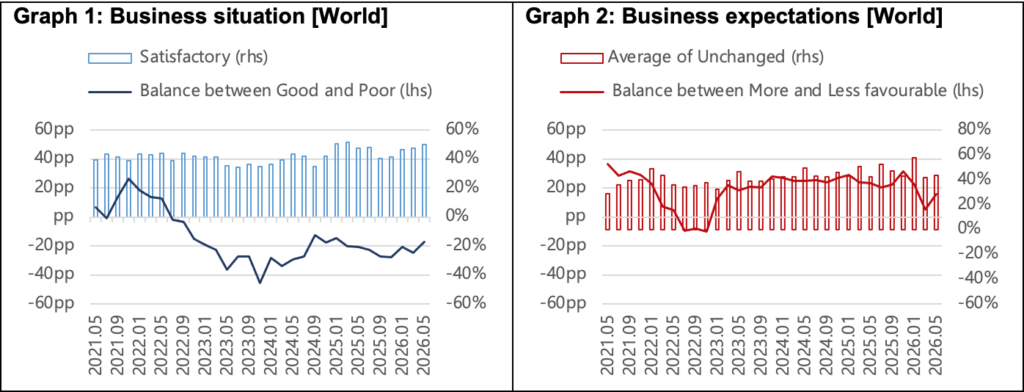
The survey found that the global business situation balance improved to negative 17 percentage points from negative 25 percentage points in March. Business expectations for the next six months rose to positive 16 percentage points, compared with positive 5 percentage points previously. Order intake also improved significantly, climbing to negative 9 percentage points from negative 25 percentage points.
Average order backlogs increased to 2.5 months, while global capacity utilisation reached 74 per cent. Inventory levels remained relatively low and order cancellations continued to be contained, providing some support for the industry’s cautious optimism.
Regionally, the recovery remains uneven. Africa recorded the strongest performance across business conditions, order intake, order backlogs and future expectations. Europe and North & Central America also reported improvements, while major Asian manufacturing hubs continued to lag behind. East Asia recorded the weakest results both in terms of current business conditions and future outlook.
Across the textile value chain, downstream segments closer to end consumers performed comparatively better than upstream and capital goods segments.
Despite the improving indicators, challenges remain significant. Weak demand continues to be the primary concern for 53 per cent of surveyed textile manufacturers. Rising raw material costs were cited by 52 per cent of respondents, while energy prices and geopolitical tensions were identified as major concerns by 42 per cent each.
ITMF noted that escalating geopolitical tensions, particularly the conflict involving Iran, have contributed to higher energy prices. Crude oil prices have reportedly approached $100 per barrel, while gasoline prices have risen by approximately 50 per cent since March, adding inflationary pressure and increasing production costs across the textile supply chain.
The federation said the sustainability of the recent improvement will largely depend on future energy price movements, global demand conditions and the resolution of ongoing geopolitical conflicts.