



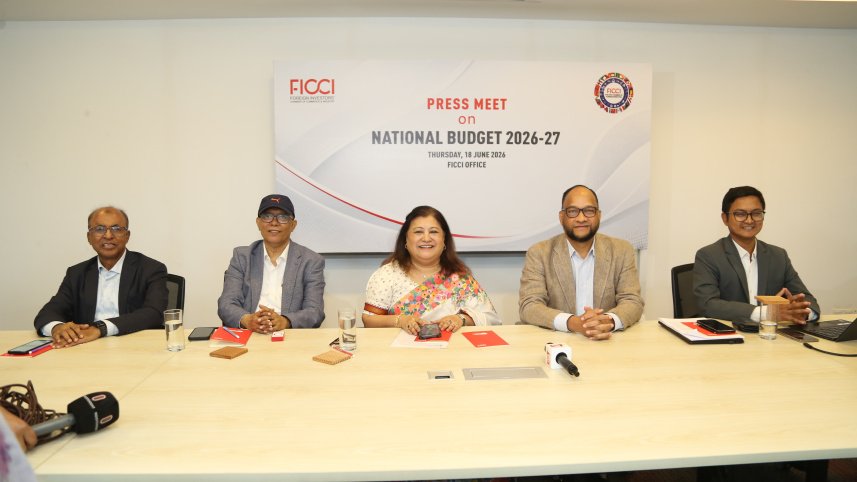
The Foreign Investors’ Chamber of Commerce and Industry (FICCI) has welcomed several investment-friendly measures proposed in the national budget, particularly those aimed at improving policy predictability, attracting foreign direct investment (FDI), controlling inflation, and maintaining fiscal stability. However, the chamber has expressed concerns regarding the government’s ambitious revenue collection target amid a slowing economy.
Speaking at a post-budget briefing held at FICCI’s office in Dhaka, FICCI President Rupali Haque Chowdhury said the proposed revenue target appears difficult to achieve given current economic conditions.
“The projected 40 percent growth in revenue collection compared to actual collection appears highly ambitious, especially when the economy is growing at around 4 percent while the GDP growth target is 6.5 percent,” she said.
Chowdhury warned that if revenue targets are not met, governments often resort to imposing supplementary duties and additional taxes, increasing pressure on compliant taxpayers while a significant portion of potential taxpayers remains outside the formal tax system.
She emphasized that the revenue gap should be addressed by expanding the tax base, improving compliance, and identifying new revenue sources rather than placing additional burdens on businesses already paying taxes.
FICCI also welcomed the government’s efforts to enhance policy consistency, noting that predictable fiscal policies are critical for long-term investment planning.
“For years, businesses have sought consistency in fiscal policies. This budget signals that corporate and personal tax policies will remain stable in the coming years, which is a positive development,” Chowdhury said.
Despite the positive direction, she noted that Bangladesh continues to face competitiveness challenges compared to regional investment destinations. She pointed out that Vietnam’s corporate tax rate is approximately 20 percent, significantly lower than Bangladesh’s 27.5 percent, while several Indian states offer extensive incentives to attract investors.
According to FICCI, Bangladesh must continuously benchmark itself against competing economies as international investors evaluate multiple destinations before making investment decisions.
Chowdhury identified Bangladesh’s large and trainable workforce as one of the country’s strongest competitive advantages but stressed that challenges related to energy supply, utility services, infrastructure, and ease of doing business continue to affect investment attractiveness.
She noted that many industries have already completed investments but remain unable to commence operations due to persistent gas shortages. In this context, she called for expanded LNG infrastructure and measures to ensure a reliable energy supply for industrial users.
The FICCI president also questioned the rationale behind utility surcharges imposed within economic zones, arguing that operating costs inside designated industrial zones should be lower than outside to encourage investment.
On foreign investment, she welcomed the proposed 1.5 percent incentive for FDI, describing it as a strong indication that Bangladesh is prioritizing foreign investors.
“FDI brings technology transfer, creates employment, and supports the development of backward-linkage industries,” she said, citing international examples where foreign investment has played a transformative role in industrial development.
FICCI further praised recent reforms in customs and tax administration, including the introduction of the Authorised Economic Operator (AEO) programme, online tax return filing systems, and broader digitization initiatives. The chamber believes these reforms have the potential to significantly improve investor confidence once fully implemented.
“The direction is positive,” Chowdhury said. “The real test will be whether existing investors expand their investments. That will be the strongest signal for new investors considering Bangladesh.”
At the briefing, FICCI Tax Consultant Snehasish Barua presented the chamber’s detailed budget observations. Also present were FICCI Vice-President Mohammad Iqbal Chowdhury, Director Habibur Rahman Bhuiyan, and Executive Director TIM Nurul Kabir.
FICCI concluded that while the budget contains several encouraging measures for investment promotion and business facilitation, effective implementation of the announced reforms will be crucial to strengthening Bangladesh’s competitiveness and attracting greater domestic and foreign investment in the coming years.