



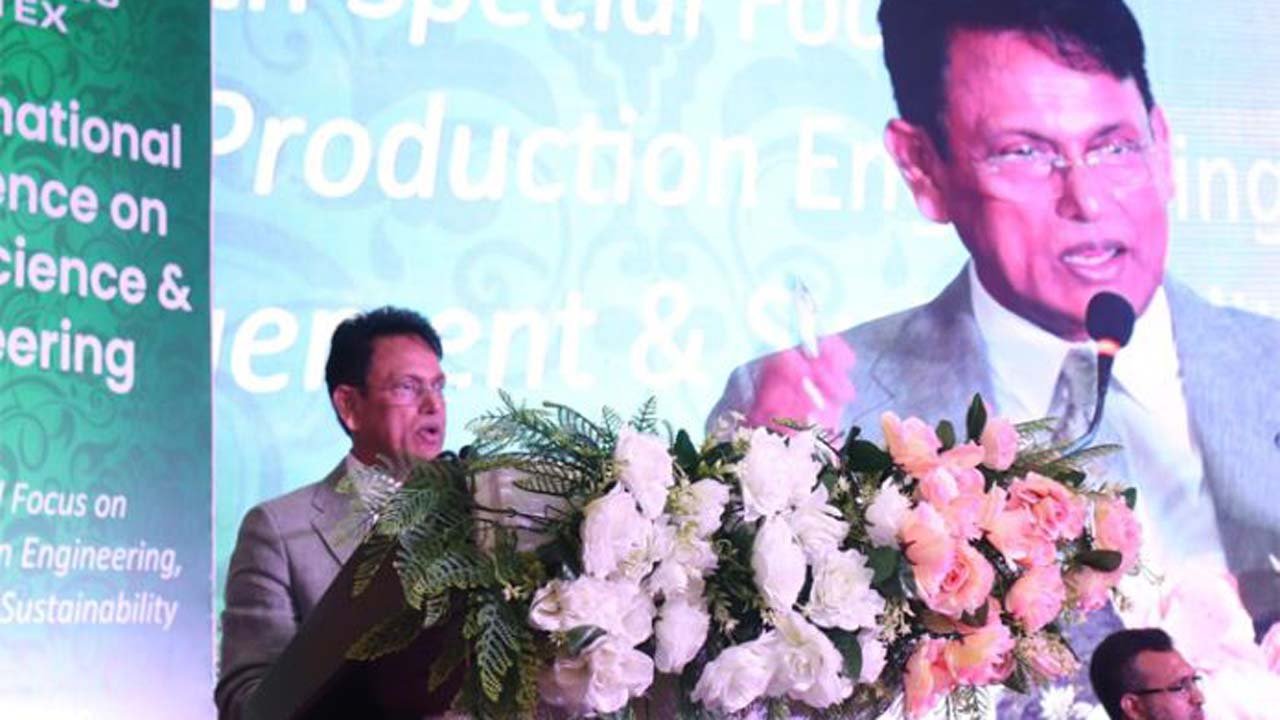
Bangladesh must accelerate innovation, adopt advanced technologies and strengthen sustainability practices to maintain its global competitiveness in the textile and apparel sector, Education Minister Dr. A.N.M. Ehsanul Hoque Milon said at the 4th International Conference on Textile Science and Engineering (ICTSE-2026) held at Bangladesh University of Textiles (BUTEX).
Organized by the Faculty of Textile Management and Business Studies (FTMBS), the conference brought together researchers, academicians, policymakers, industry leaders and students from home and abroad to discuss emerging trends and future challenges in textile production engineering, management and sustainability.
Speaking as the chief guest at the inaugural session, Dr. Milon emphasized the importance of research, innovation and technology adoption in sustaining Bangladesh’s position in the global textile and apparel market.
“The future of the textile industry will be shaped by innovation, compliance, sustainability and recycling. Strategic investments in these areas can position Bangladesh at the forefront of the global textile and apparel industry,” he said.
The minister noted that the textile and apparel sector employs nearly six million people and remains one of the country’s largest economic contributors. He stressed that digitalization and artificial intelligence should be viewed as opportunities to enhance productivity, product quality, design capabilities and global marketing rather than threats to employment.
The conference was chaired by BUTEX Vice-Chancellor Prof. Dr. Md. Zulhash Uddin, while FTMBS Dean Prof. Dr. Ahasan Habib delivered the welcome address. University Grants Commission (UGC) Chairman Prof. Dr. Mamun Ahmed attended the event as special guest.
Prof. Dr. Mamun Ahmed highlighted the importance of skill-based education and stronger industry-oriented learning, emphasizing that future graduates must combine theoretical knowledge with practical expertise and innovative thinking to meet evolving industry demands.
In his remarks, Prof. Dr. Md. Zulhash Uddin underscored BUTEX’s contribution to developing skilled textile professionals and called for enhanced research infrastructure, advanced laboratories and greater investment in innovation-driven education.
A key attraction of the conference was a virtual keynote presentation by Prof. Dr. Bastian Quattelbaum of Hochschule Niederrhein University of Applied Sciences, Germany. In his presentation titled “Weaving the Future,” he argued that efficiency alone is no longer sufficient to ensure competitiveness. Instead, sustainability, digitalization, innovation and interdisciplinary collaboration must be integrated into a holistic development strategy.
He also emphasized the need for greater knowledge-sharing among different disciplines and cautioned that the environmental impact of digital technologies should be carefully evaluated alongside their benefits.
Another notable presentation was delivered by Michiel Kokken, Chair of the Technical Working Group for the Jute and Cocoa Sector under the Ministry of Health of the Netherlands and Head of Scientific and Regulatory Affairs at OFI. He highlighted the growing global potential of jute as a renewable and biodegradable packaging material that can support circular economy initiatives.
Kokken noted that mineral oil hydrocarbon contamination (MOSH/MOAH) remains a challenge for food-grade jute packaging but said Bangladesh is well-positioned to lead the development of safe and sustainable jute-based packaging solutions for international food and cocoa supply chains.
The conference attracted significant international interest, receiving 258 abstract submissions. Following a rigorous peer-review process, 48 papers were selected for oral presentation and 20 for poster presentation.
Technical sessions covered a broad range of topics, including Industry 5.0, artificial intelligence, Internet of Things (IoT) applications in textiles, sustainable manufacturing, advanced materials, textile composites, green production systems, supply chain management and textile waste management.
ICTSE-2026 concluded with active participation from national and international delegates, reinforcing BUTEX’s commitment to advancing textile science, engineering, management and sustainability. Participants said the conference created new opportunities for research collaboration, innovation and knowledge exchange, supporting Bangladesh’s transition toward a more competitive, technology-driven and sustainable textile industry.