



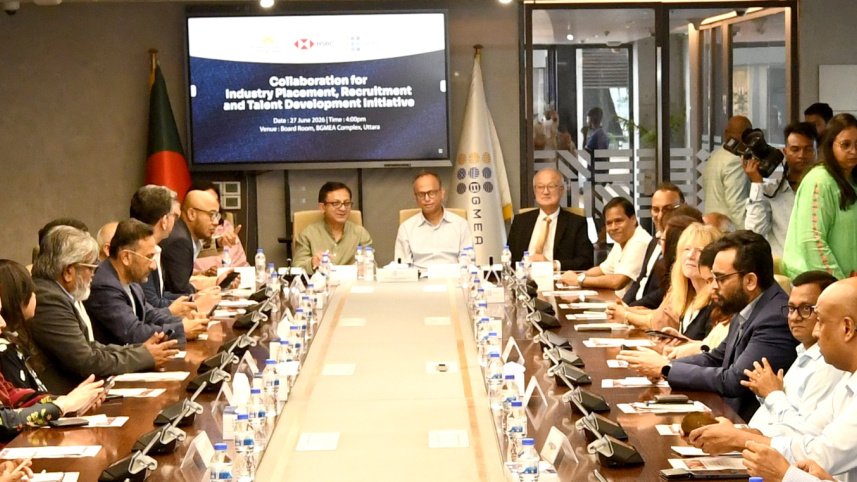
The government is planning to establish another floating liquefied natural gas (LNG) terminal to ensure a reliable energy supply for industries, a move aimed at boosting industrial production, employment and export competitiveness, Commerce Minister Khandakar Abdul Muktadir has said.
Speaking at an industrial placement and recruitment talent event jointly organized by the Bangladesh Garment Manufacturers and Exporters Association (BGMEA) and the HSBC–AUW School of Apparel at the Asian University for Women (AUW), the minister said the proposed terminal is expected to supply an additional 550–600 million cubic feet of gas per day to the national grid.
He noted that inadequate gas supply has prevented many industrial units from commencing production, making uninterrupted energy one of the government’s highest priorities.
“Reliable energy supply is essential for increasing industrial output, creating employment and expanding exports,” the minister said.
Reforms to Improve Investment Climate
Muktadir said the government is implementing a series of fast-track reforms to attract investment and accelerate industrialization. The initiatives include streamlining business registration, simplifying licensing procedures, modernizing port management and strengthening energy infrastructure.
As part of the reforms, the government has significantly reduced the time required to start a business, with an initiative to provide initial approval for company registration within 14 days.
He added that Bangladesh is introducing a one-stop online service platform, an integrated inspection system and modern port management practices, drawing on successful models adopted in Singapore and Malaysia.
RMG Remains Export Backbone
The commerce minister noted that the ready-made garment (RMG) industry continues to dominate Bangladesh’s export sector, contributing around 85% of the country’s total export earnings.
While acknowledging efforts to diversify exports, he said no other industry is expected to match the scale of the apparel sector in the near future, underscoring the importance of ensuring uninterrupted utility services and a business-friendly environment for manufacturers.
Industry-Academia Collaboration
The event also highlighted the need for stronger collaboration between industry and academia to develop a skilled workforce for the apparel sector.
Asian University for Women Vice Chancellor Rubana Huq called on BGMEA member factories to sponsor female professionals for the university’s Master of Science in Apparel and Retail Management programme, saying the initiative would help build the next generation of industry leaders.
She emphasized that greater investment in higher education would strengthen expertise in key areas such as supply chain management, sustainability and industrial engineering.
BGMEA President Mahmud Hasan Khan welcomed the proposal, stating that the association would encourage member factories to participate in the sponsorship programme as part of its long-term strategy to enhance the global competitiveness of Bangladesh’s apparel industry through human capital development.
The HSBC–AUW School of Apparel was established to develop highly skilled women professionals for Bangladesh’s RMG sector. The programme is expected to strengthen leadership capacity while supporting the industry’s long-term sustainability and competitiveness.
The event also featured discussions on internship opportunities, graduate recruitment and the importance of closer cooperation between universities and the apparel industry to meet future workforce demands.
Among others, Youngone Corporation Chairman Kihak Sung, Asian University for Women Founder Kamal Ahmad, former BGMEA President Kutubuddin Ahmed and HSBC Bangladesh Head of Sustainability Syeda Afzalun Nessa also addressed the programme.