



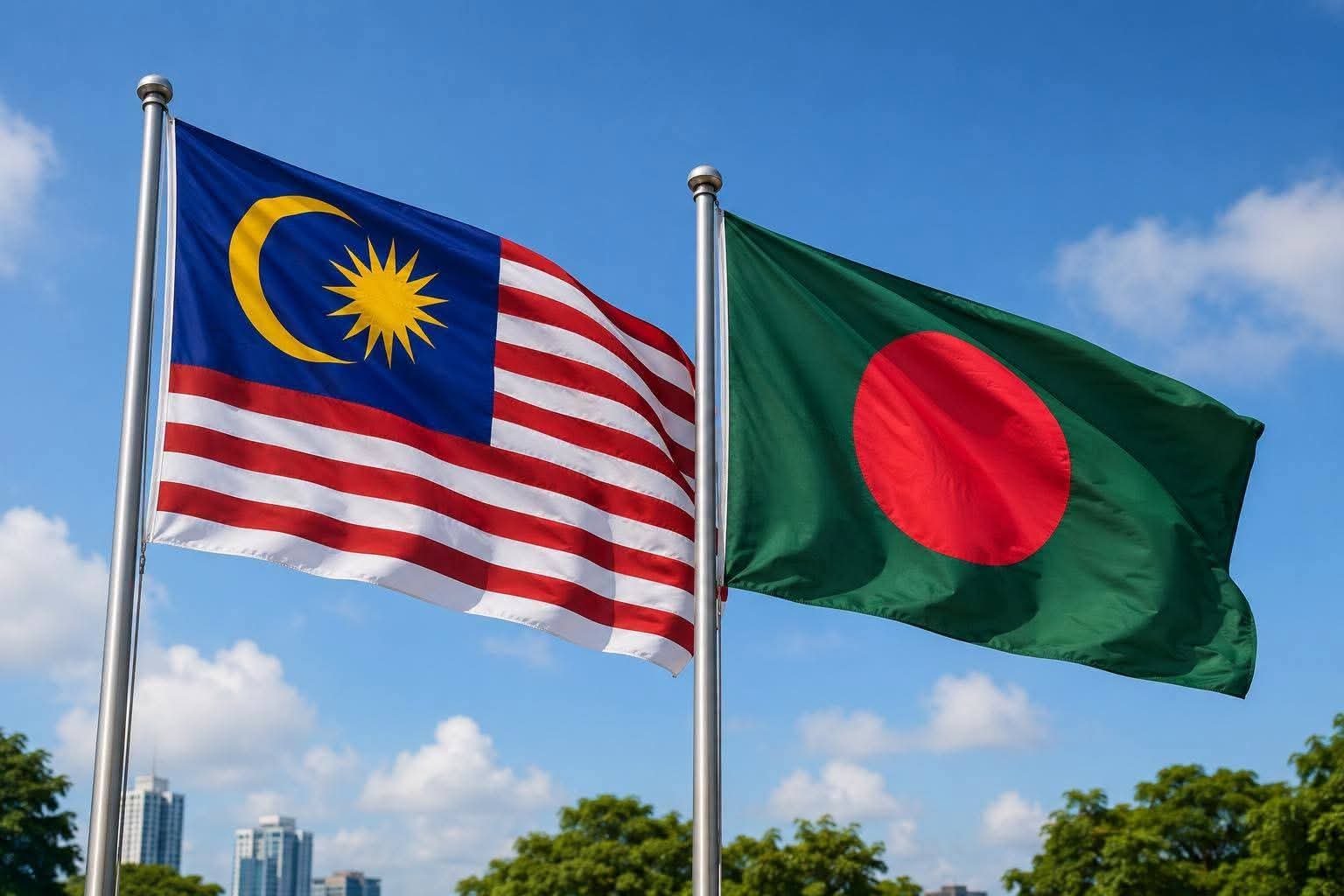
Bangladesh and Malaysia have agreed to accelerate negotiations on a bilateral Free Trade Agreement (FTA), with both countries aiming to finalize the deal by 2027 as part of broader efforts to strengthen economic and strategic ties.
The commitment was announced in a joint statement issued following bilateral talks between Prime Minister Tarique Rahman and Malaysian Prime Minister Anwar Ibrahim during the Bangladeshi leader’s official visit to Putrajaya.
The two leaders reaffirmed their commitment to elevating Bangladesh-Malaysia relations and agreed to revive the long-pending Joint Commission Meeting and bilateral consultation mechanisms to facilitate closer cooperation across multiple sectors.
Recognizing Bangladesh as Malaysia’s second-largest trading partner in South Asia, both countries pledged to enhance bilateral trade and investment and expressed support for the establishment of a Malaysia-Bangladesh Joint Business Council to strengthen private-sector engagement.
Focus on Trade, Investment and Technology
The two sides identified several priority sectors for future collaboration, including telecommunications, energy, infrastructure, ports and logistics, halal industries, agro-processing, semiconductor manufacturing, smart industries and the digital economy.
Bangladesh and Malaysia also agreed to deepen cooperation in emerging technologies such as artificial intelligence, fintech, cybersecurity and digital governance as both countries pursue digital transformation and innovation-driven growth.
Labour Migration Framework Under Review
Labour migration featured prominently in the discussions. Malaysia acknowledged Bangladesh’s proposals concerning worker recruitment while reiterating that future foreign worker quotas would continue to be determined by employer demand and sector-specific requirements.
To strengthen labour cooperation, both countries agreed to convene a Joint Working Group to review the existing labour Memorandum of Understanding (MoU) and develop a new framework aimed at ensuring safe, orderly and mutually beneficial migration.
Expanding Education Cooperation
The leaders also emphasized the importance of educational collaboration, noting that approximately 11,000 Bangladeshi students are currently pursuing higher education in Malaysia.
Both sides pledged to expand university partnerships, joint research initiatives, academic exchanges and technical education programs to support human resource development and knowledge sharing.
Energy and Defence Collaboration
In the energy sector, Bangladesh invited Malaysian investors to explore opportunities in offshore oil and gas exploration, mineral resource development and renewable energy projects. The two countries also reaffirmed cooperation in liquefied natural gas (LNG) supply and energy infrastructure development.
Defence cooperation was another key area of discussion. Both governments agreed to strengthen collaboration through military training programs, technical exchanges, defence industry partnerships, counter-terrorism cooperation and intelligence sharing.
Strengthening a Strategic Partnership
The discussions reflect a growing commitment by both countries to build a comprehensive partnership encompassing trade, investment, labour mobility, education, energy security, technology and defence.
Officials from both sides expressed optimism that the proposed FTA and expanded sectoral cooperation would create new opportunities for businesses, investors and skilled professionals while contributing to stronger economic integration between Bangladesh and Malaysia.