



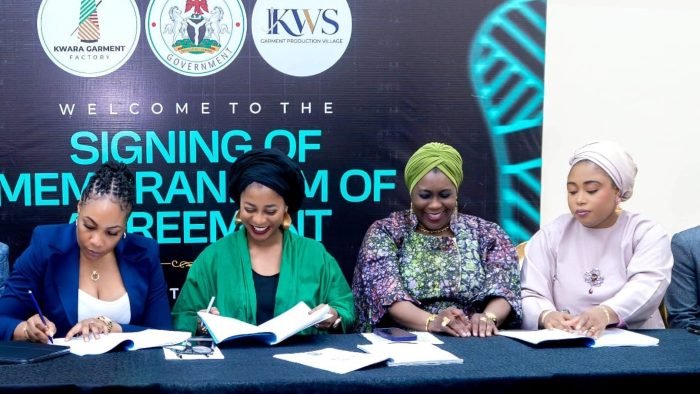
Kwara Garment Factory Limited, a state-owned apparel manufacturing facility in Nigeria, has signed a management agreement with KWS Garment Production Village to oversee and operate the factory under a private-sector-led management structure.
The agreement was signed at the factory premises in Ilorin by Managing Director Bukola Adedeji.
Under the agreement, both parties committed to ensuring that at least 80 percent of the factory’s production workforce will consist of women and indigenous residents of Kwara State, reflecting a broader focus on inclusive employment and local economic development.
KWS Garment Production Village is led by Folake Akindele, a prominent figure in the African fashion industry with more than three decades of experience.
According to Damilola Yusuf-Adelodun, commissioner at the Ministry of Business, Innovation and Technology, the management structure has been carefully designed to safeguard the state’s investment while enabling operational efficiency and private-sector expertise.
“This occasion marks another bold step in the commitment of the Kwara State Government under AbdulRahman AbdulRazaq towards industrialisation, economic growth, job creation and sustainable development,” Adedeji said during the signing ceremony.
Highlighting the factory’s potential, Akindele said the facility represents a major opportunity for Nigeria’s apparel manufacturing sector to achieve internationally competitive production standards locally.
“If you have been going outside Africa to manufacture and access world-class quality, you can get that same standard right here,” she said.
The factory is equipped with industrial-grade machinery covering the entire apparel production chain, including cutting, sewing, embroidery, printing, finishing, quality control and shipping.
The facility has been designed to support large-scale garment manufacturing across multiple segments, including fashion apparel, uniforms, sportswear, hospitality wear, institutional garments and corporate clothing.
Industry observers believe the partnership could strengthen domestic textile and apparel manufacturing in Nigeria while creating employment opportunities and reducing dependence on imported apparel products.