



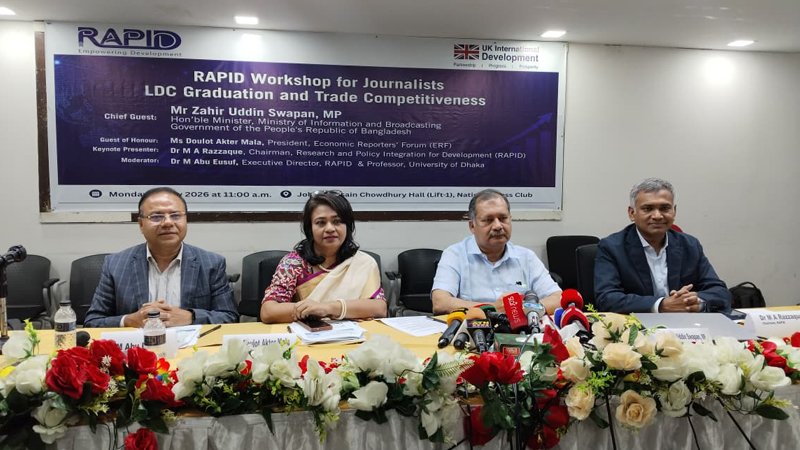
Bangladesh’s export performance has remained largely stagnant over the past four years, while regional competitors such as Vietnam and Cambodia continue to expand rapidly, underscoring the urgent need for structural reforms, export diversification and stronger investment, according to a new study by the Research and Policy Integration for Development (RAPID).
The findings were presented at a workshop held at the National Press Club in Dhaka on Monday, where RAPID cautioned that long-standing structural weaknesses—rather than the country’s upcoming graduation from the Least Developed Country (LDC) category—pose the greatest challenge to Bangladesh’s export competitiveness.
Presenting the keynote paper, RAPID Chairman Dr MA Razzaque said Bangladesh’s merchandise exports have remained around US$48 billion for four consecutive years, despite a nearly 7% increase in global exports during the same period. In comparison, Vietnam recorded export growth of 16.8%, while Cambodia achieved 17.3% growth, reflecting their stronger competitiveness in international markets.
The study attributes Bangladesh’s weak export performance to limited product diversification, low foreign direct investment (FDI), rising production costs and persistent structural constraints that have gradually eroded the country’s competitive edge.
According to the report, Bangladesh maintained steady export growth before the COVID-19 pandemic, with exports increasing from US$31.1 billion in FY2015 to US$40.5 billion in FY2019. Although exports rebounded to US$52.1 billion in FY2022 following the pandemic-induced decline, they fell to US$46.4 billion in FY2023, slipped further to US$44.5 billion in FY2024, and have remained around US$48 billion during FY2025-26.
RAPID also highlighted a gradual decline in the economy’s export orientation. Bangladesh’s export-to-GDP ratio fell from 15.2% in 2014 to 10.6% in 2025, while the trade-to-GDP ratio dropped from 35.8% to 25.9% over the same period, indicating a reduced contribution of international trade to productivity, technology adoption and employment generation.
The study noted that more than 80% of Bangladesh’s exports continue to come from the ready-made garment (RMG) sector, with nearly 71% consisting of cotton-based apparel, despite non-cotton garments accounting for around 59% of global apparel demand. This concentration has left Bangladesh heavily dependent on a narrow product base within a single industry.
RAPID further observed that between 2005 and 2019, less than 5% of Bangladesh’s export growth originated from new products. In contrast, new products contributed 41.5% of export growth in Vietnam, 31.9% in China and 77.7% in Malaysia, demonstrating the importance of innovation and diversification in sustaining export competitiveness.
The report concluded that Bangladesh has primarily expanded exports by increasing the volume of existing products rather than developing new industries and higher-value export categories, limiting its ability to compete in evolving global markets.
Speaking as the chief guest, Information Minister Zahir Uddin Swapan said Bangladesh must prepare strategically for the challenges associated with LDC graduation by placing greater emphasis on export-led economic growth.
“We have no alternative but to face the challenges that will come with LDC graduation. We must structure our economy by prioritising exports,” he said.
The minister added that the government, under the leadership of Prime Minister Tarique Rahman, remains committed to incorporating policy recommendations from researchers and industry stakeholders into its future economic roadmap.